At R2R our work with rhythm stems from an understanding of the way in which music impacts the brain to support human bonding, improve learning retention and increase emotional regulation.
Percussive, rhythmic music acts as a safe platform for engagement & social connection. For many people with anxiety and other mental health conditions, social connection is challenging and the direct questioning of traditional talk-based therapies can be confronting. For these individuals, the group music circle is a fun, safe and uplifting way to connect with others. Over 20 separate research studies have found participants experience a significant improvement in mood & self-concept from these sessions. Drumming also has a strong cathartic element, allowing people to release pent up feelings safely. As trust builds in the musical circle, so the reflective element increases leading to increased self-awareness and opportunities to work through some of life’s challenges with the help of other group members and supportive health professionals.
Click here to read a recent journal article on our work and its relationship to Trauma Informed Care
Click here to read an article on the relationship between drumming and Somatic Therapy
Click Here to read an article on the link between Drumming and Polyvagal Theory
Our ancestors have known the healing power of rhythmic music for centuries, with almost all indigenous cultures having a traditional role for music in their healing ceremonies. The drum more than any other instrument had been used in this way; to bring people together, to assist with communication, to transport people to a spiritual dimension, and to heal the restless spirit.
Now through the work of a small band of trauma specialists working in the neuroscience field we have scientific support for the way rhythmic music impacts the centres of the brain, (amygdaloid, hippocampus, hypothalamus, and brain stem) that are responsible for how we process trauma. These areas dictate our behavioural responses and are virtually free from the influence of cognition – hence the limited scope for talk-based therapies in supporting people who are living with this form of emotional pain. This research now sees physical, body orientated, therapies such as drumming as key elements of best practice, trauma informed care.
Many of the leading experts in the trauma field have thrown their support around the need for ‘patterned, repetitive, sensory input, such as drumming and music’ that can influence the brain-stem, diencephalon or midbrain region to reorganise and reduce the hypersensitivity, impulsivity and anxiety associated with its dysregulated state. These primal centres of the brain are organised in the womb under the influence of rhythmic sensory input (the maternal heartbeat), which is associated with warmth and security. Rhythmic interventions, at the correct tempo, can assist in realigning brain stem activity to reduce arousal and improve emotional stability. The auditory-motor connection is central to this process with the brain’s ability to integrate auditory information with motor planning and execution, allowing rhythmic sound to entrain (synchronize) movement and modulate arousal.
Our work at R2R extends the use of rhythm to reach primal brain centres across to the relational and reflective elements of therapy to engage the whole brain. Combining stabilising and comforting musical play with safe social interconnection and a small degree of self reflection provides the client with a ‘full brain’ healing experience. The drumming also provides a safe form of communication and a receptacle for the constructive release of feelings.
Hand Drumming vs Stick Drumming in Therapy
Published evidence
Rhythm and Regulation
Click here to see how rhythmic music can support emotional regulation
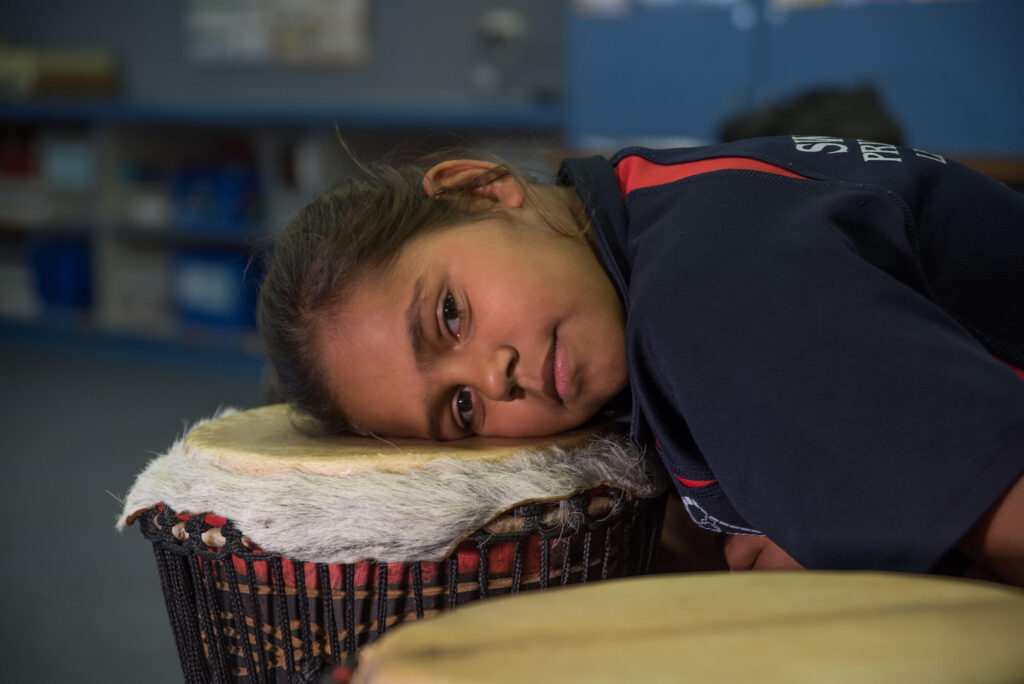
“Integrate the senses through Rhythm – Rhythmical interactions can help establish internal sensory integration. Experiences like drumming put one organism in rhythm with another organism, overcoming the frozen sense of separation that traumatised people have with others.” – Bessel Van der Kolk – Key Steps to Trauma Recovery.
“Creative therapies, like drumming, enable a therapeutic attunement, through an embodied awareness of rhythmic flow, and the mutual connection that occurs where there is an intense process of deep listening, kinesthetic awareness, and deep attention to what is happening in the moment.” – Dr Michael Kossak – Attunement in Expressive Arts Therapies.
“Rhythmic exercises, such as drumming are central to the clinical application of our growing understanding of neurobiology; in particular the impact of dysregulation of primal brain function due to trauma or neglect. Both the brainstem and diencephalon or midbrain region are strongly affected by rhythms as they organize in the womb and during the first years of life. Somatosensory interventions that provide patterned, repetitive, neural input into the brainstem and diencephalon monoamine neural networks, assist with the realignment of homeostatic systems and help reduce anxiety, impulsivity and other trauma related symptoms”. Dr Bruce Perry – The Neurosequential Model of Therapeutics